
Orthodontics & Specialty Care
Orthodontic Expanders in Jenkintown, PA
Widening a narrow upper arch while the palate is still developing.
An expander is a fixed appliance that applies gentle outward pressure across the upper arch. In a child whose palate has not yet fused, that pressure widens the arch itself – creating room that would otherwise have to be found by removing teeth later.
Exceptional care for a lifetime of healthy smiles
The short answer
Expanders at MVP Family Dental
Palatal expander appliances that widen the upper jaw to correct crossbites, create space for crowded teeth, and improve breathing.
The upper jaw is formed from two halves joined by a suture running front to back along the palate. In children that join is still able to respond to gentle pressure, which is what allows the arch to be genuinely widened rather than the teeth simply tipped outward.
That window is the reason expanders are a childhood appliance. Once the suture has fused, widening the arch becomes a different and considerably larger undertaking.
How it works
Fitted, then turned
The appliance is fixed in place and adjusted in very small increments, usually by a parent at home following a schedule set by the dentist.
- Assessment and recordsThe arch width, the bite and the stage of development are assessed, with imaging where it helps.
- Fitting the expanderThe appliance is cemented to the upper back teeth. It is fixed – it does not come out.
- The activation scheduleA small key turns a screw at the center by a set amount on a set schedule. Your dentist will show you exactly how.
- Holding the resultOnce the target width is reached the appliance stays in place while new bone fills in across the join.
Why widen an arch
Space, bite and airway
Expansion is not only about making room for teeth, although that is the most common reason.
- Making roomA wider arch can accommodate teeth that would otherwise be crowded out of the line.
- Correcting a crossbiteWhere upper teeth are biting inside the lower ones, widening the upper arch corrects the relationship.
- Helping teeth eruptAn adult tooth with nowhere to come through may be blocked simply by lack of width.
- Reducing later extractionsCreating space during growth can mean fewer teeth need removing to achieve alignment afterwards.
Types of expander
Different designs, same principle
Which design is used depends on the age, the teeth available to anchor to and what the case needs. Your dentist will explain the choice for your child.
-
Rapid palatal expander
Fixed to the upper back teeth and activated in small daily increments over a short period.
-
Slow expanders
Apply lighter force over a longer period, used where a more gradual change suits the case.
-
Removable expanders
A plate the child takes out to clean. Depends on being worn, so it is used where that is realistic.
Is it right for your child
Timing is the deciding factor
Expansion works while the palatal suture can still respond, so the assessment is largely about developmental stage rather than age in years. Imaging and examination establish where a particular child is in that process.
It is also usually one part of a plan rather than the whole of it. Widening the arch creates the conditions for alignment; aligning the teeth within it is often a separate later step.
- During growthExpansion depends on the palatal suture still being able to respond.
- Fixed applianceMost expanders are cemented in place, so nothing depends on remembering to wear it.
- Part of a planWidening usually sets up later alignment rather than completing it.
Worth asking about
- Whether your child is at the right stage for expansion.
- How the activation schedule works and who does it.
- How long the appliance stays in after the target width is reached.
- What the next stage of the plan is likely to be.

Living with an expander
Odd at first, then normal
Speech and eating usually feel strange for the first days while the tongue adapts, and a gap can appear between the upper front teeth as the arch widens – that is expected rather than a problem, and it is managed as part of the plan.
Cleaning takes more care because food collects around the framework. Rinsing after meals and brushing carefully around the appliance keeps the gums comfortable. Sticky and hard foods are best avoided while it is in.
Making room during growth is easier than making room afterwards.
MVP Family Dental · Jenkintown, PA
Orthodontic Expander Questions
- What does a palatal expander do?
- It applies gentle outward pressure across the upper arch. In a child whose palatal suture has not yet fused, this widens the arch itself rather than just tipping the teeth outward.
- Does it hurt?
- There is commonly a feeling of pressure after each activation, and sometimes in the nose or between the eyes. It usually settles quickly. Tell us if it does not.
- Who turns the screw?
- Usually a parent at home, on a schedule set by the dentist. You will be shown exactly how before you leave with the appliance.
- Will a gap appear between the front teeth?
- Often, and it is expected as the arch widens. It is managed as part of the treatment plan rather than being a problem.
- Can it be taken out?
- Most expanders are cemented to the upper back teeth and stay in place for the whole of treatment. Removable versions exist and depend on being worn.
- Will my child still need braces?
- Often yes. Expansion creates the space; aligning the teeth within the widened arch is usually a separate later stage.
- Can adults have an expander?
- Once the palatal suture has fused, widening the arch becomes a considerably larger undertaking. Your dentist will explain what the options are in an adult case.
- How is eating and speaking affected?
- Both usually feel strange for the first few days while the tongue adapts, then settle. Sticky and hard foods are best avoided while the appliance is in.

Dr. Vineetha Thomas, D.M.D.
LEARN MORE
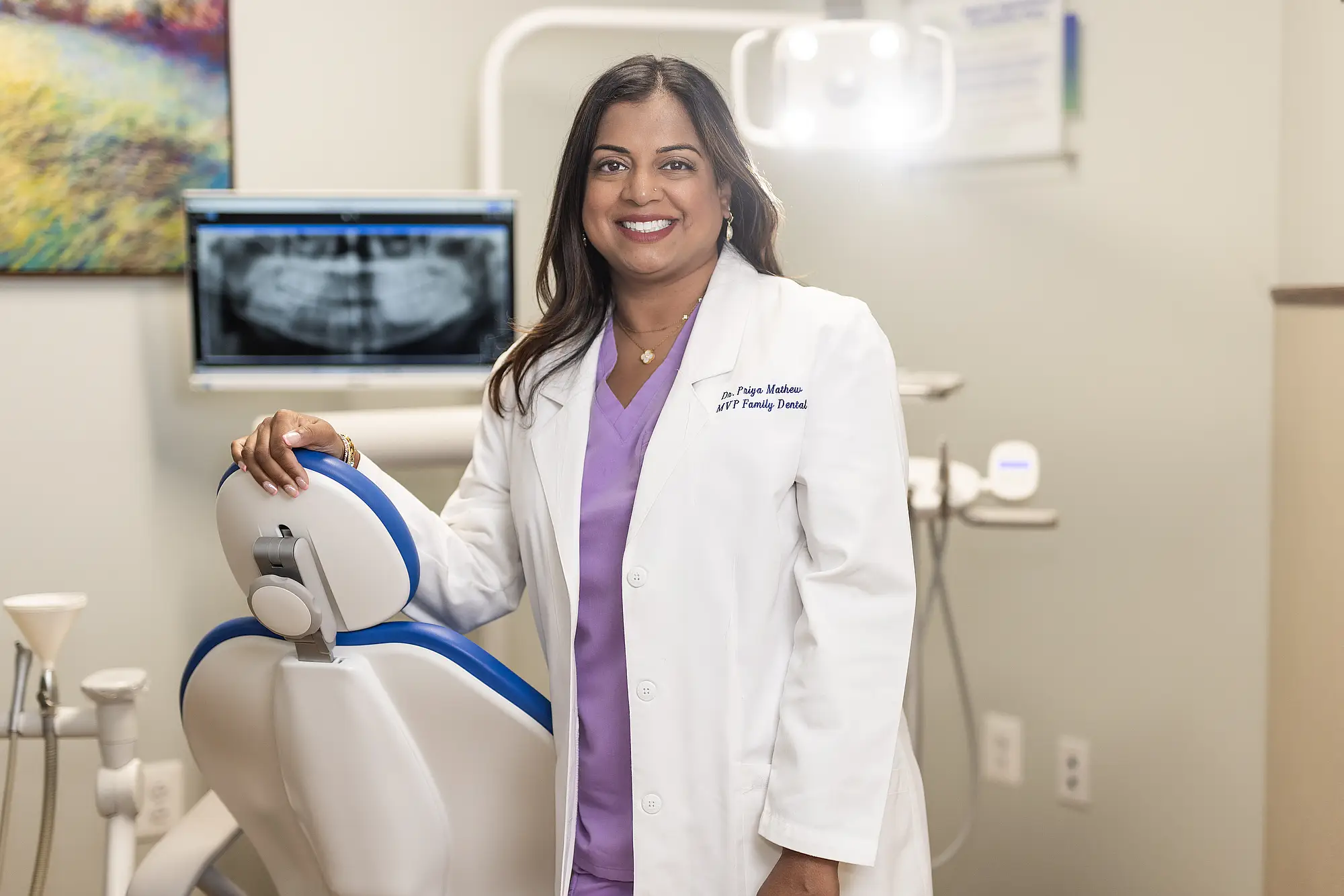
Dr. Priya Mathew, D.M.D.
LEARN MORE