
Orthodontics & Specialty Care
Retainers in Jenkintown, PA
The part of orthodontic treatment that never actually finishes.
Teeth that have been moved will drift back toward where they came from. That is not a sign anything went wrong – it is simply how teeth behave. A retainer holds the result while the bone and fibers around each root settle, and then keeps holding it.
Exceptional care for a lifetime of healthy smiles
The short answer
Retainers at MVP Family Dental
Custom orthodontic retainers worn after braces or aligner treatment to hold teeth in their new positions and prevent relapse.
When a tooth is moved, the fibers attaching it to the surrounding bone are stretched, and they pull. The bone around the new position also needs time to reorganize. Until both have settled, the tooth is being actively pulled back toward where it started.
Teeth also keep shifting slowly throughout life, whether or not they were ever straightened. That is why retention is usually described as long-term rather than as a phase that ends.
How retention works
Full-time, then part-time
Retention typically starts intensively and eases off. The specific schedule is set by your dentist for your case.
- Fitted as treatment endsRecords are taken as the appliance comes off, so the retainer matches the result exactly.
- Full-time wear at firstThe early period is when teeth are most inclined to move, so wear is heaviest then.
- Reducing to nightsWear is usually stepped down over time to night-time only, on the schedule your dentist sets.
- Checked at routine visitsFit is checked as part of ordinary dental visits, since a retainer that no longer seats is not retaining.

What goes wrong
Four ways people lose the result
Relapse is almost always one of these, and all four are avoidable.
- Stopping too soonWearing the retainer while it feels necessary and stopping when it does not is the most common route back to crooked teeth.
- A retainer that no longer fitsIf it has become tight or will not seat, teeth have already moved. Contact us rather than forcing it.
- Losing it and waitingThe longer the gap before a replacement, the more the teeth move in the meantime.
- Damage from heatHot water, a dishwasher or a hot car will distort the material, and a distorted retainer no longer holds the shape it was made to.
Types of retainer
Fixed, removable, or both
Which retainer suits you depends on what was moved and how likely those teeth are to want to move back. Many people end up with a combination.
-
Clear removable retainers
A thin transparent tray made to your finished tooth positions. Discreet, and taken out to eat and clean.
-
Fixed bonded retainers
A thin wire bonded behind the teeth, usually at the front. Nothing to remember, but it needs careful cleaning around.
-
Retainer replacement
Custom fabrication of new retainers to replace lost, broken or worn-out ones and maintain tooth position.
If it has been a while
Teeth have already moved
If you stopped wearing a retainer years ago and your teeth have shifted, a new retainer will hold them where they are now – it will not move them back. Whether that is acceptable, or whether a short course of alignment first makes sense, is worth a conversation.
Either way it is better to act than to wait. Teeth continue to drift, so the position you are considering holding today is the best one available from here on.
- Holds, does not moveA retainer maintains the current position; it does not correct teeth that have already drifted.
- Long termRetention is generally described as indefinite, reducing to night-time wear.
- ReplaceableA lost or broken retainer can be remade – the sooner the better.
Contact us if
- Your retainer has been lost, cracked or has stopped fitting.
- A bonded retainer wire feels loose or has come away from a tooth.
- You stopped wearing one and your teeth have visibly shifted.
- You are unsure how often you should still be wearing it.

Looking after it
Cool water, and its case
Clean a removable retainer with cool water and a soft brush, and let it dry before it goes back in its case. Never use hot water and never put it in a dishwasher – heat distorts the material permanently.
A bonded retainer needs threading floss or an interdental brush to clean behind the wire. Plaque collects there readily and it is not somewhere a toothbrush reaches on its own.
Braces move the teeth. Retainers are what you actually keep.
MVP Family Dental · Jenkintown, PA

Retainer Questions
- Why do I need a retainer?
- Teeth drift back toward their previous positions after being moved, because the fibers around each root are stretched and the bone is still reorganizing. A retainer holds the result while that settles.
- How long do I have to wear it?
- Retention is generally long term, usually stepping down from full-time wear to nights only. Your dentist will set the schedule for your case.
- What is the difference between fixed and removable retainers?
- A fixed retainer is a thin wire bonded behind the teeth – nothing to remember, but it needs careful cleaning. A removable one is a clear tray you take out to eat and clean.
- My retainer feels tight. Should I force it?
- No. Tightness means the teeth have already moved. Contact us and we will check the fit rather than risk damaging the retainer or the teeth.
- I lost my retainer. What now?
- Contact us as soon as you can. The longer the gap before a replacement, the more the teeth move in the meantime.
- Can a retainer straighten teeth that have already shifted?
- No. A retainer holds the current position. Moving teeth back requires orthodontic treatment, which may be a short course depending on how far they have drifted.
- How do I clean it?
- Cool water and a soft brush, then let it dry in its case. Never hot water and never a dishwasher – heat distorts the material permanently.
- Can I get a replacement made?
- Yes. Contact our Jenkintown office and we will arrange for a new one to be fabricated.

Dr. Vineetha Thomas, D.M.D.
LEARN MORE
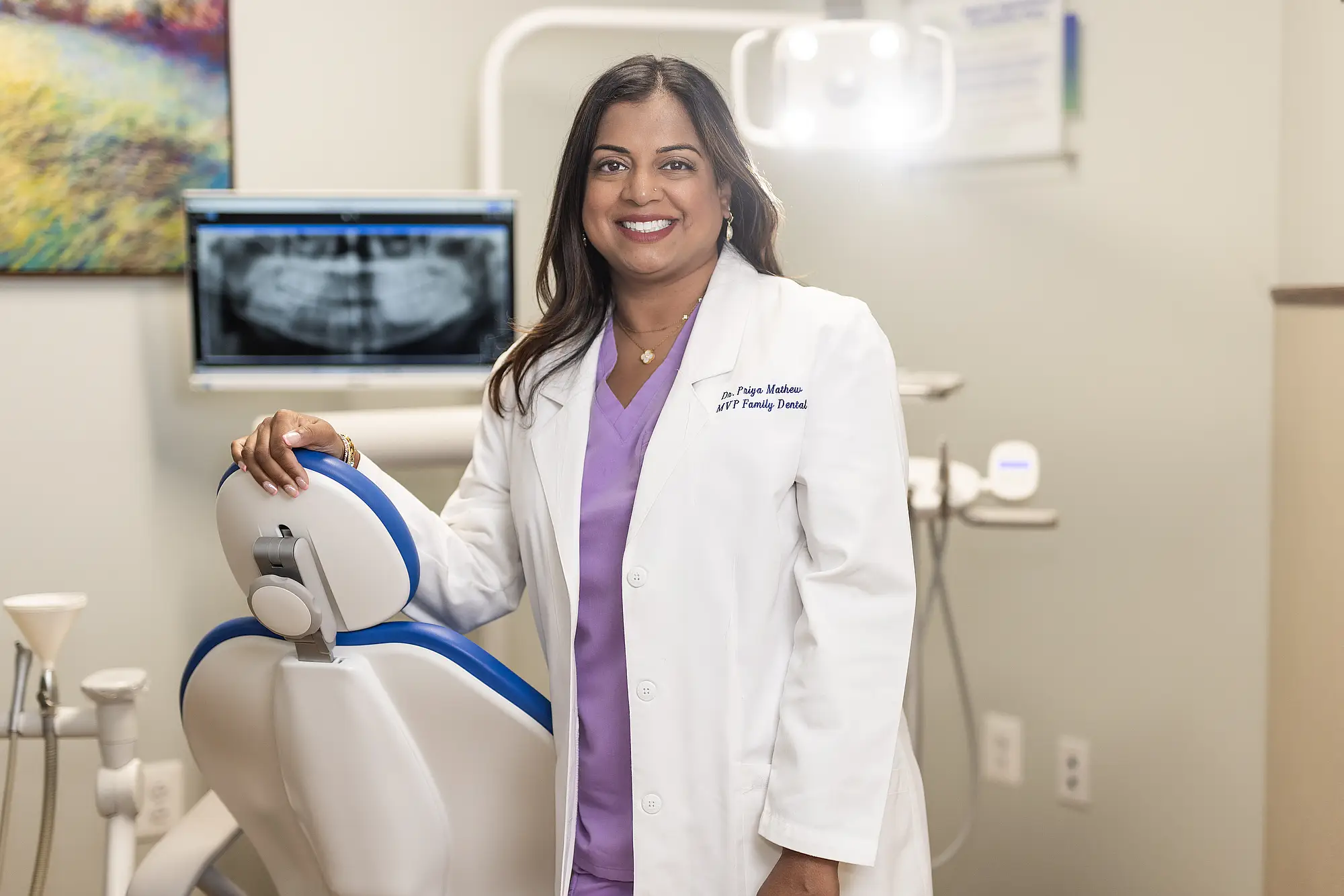
Dr. Priya Mathew, D.M.D.
LEARN MORE